











Extreme Programming Process Cycle Template for PowerPoint & Google Slides
Extreme Programming Process Cycle Template for PowerPoint & Google Slides
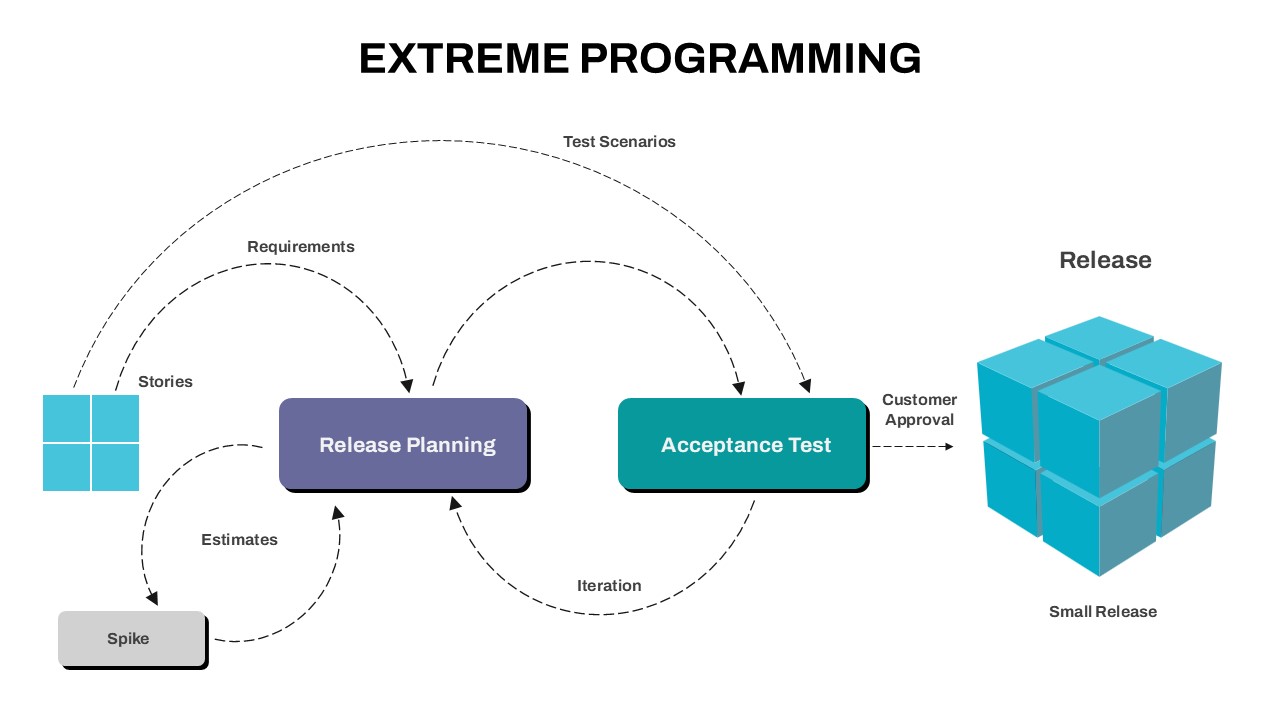
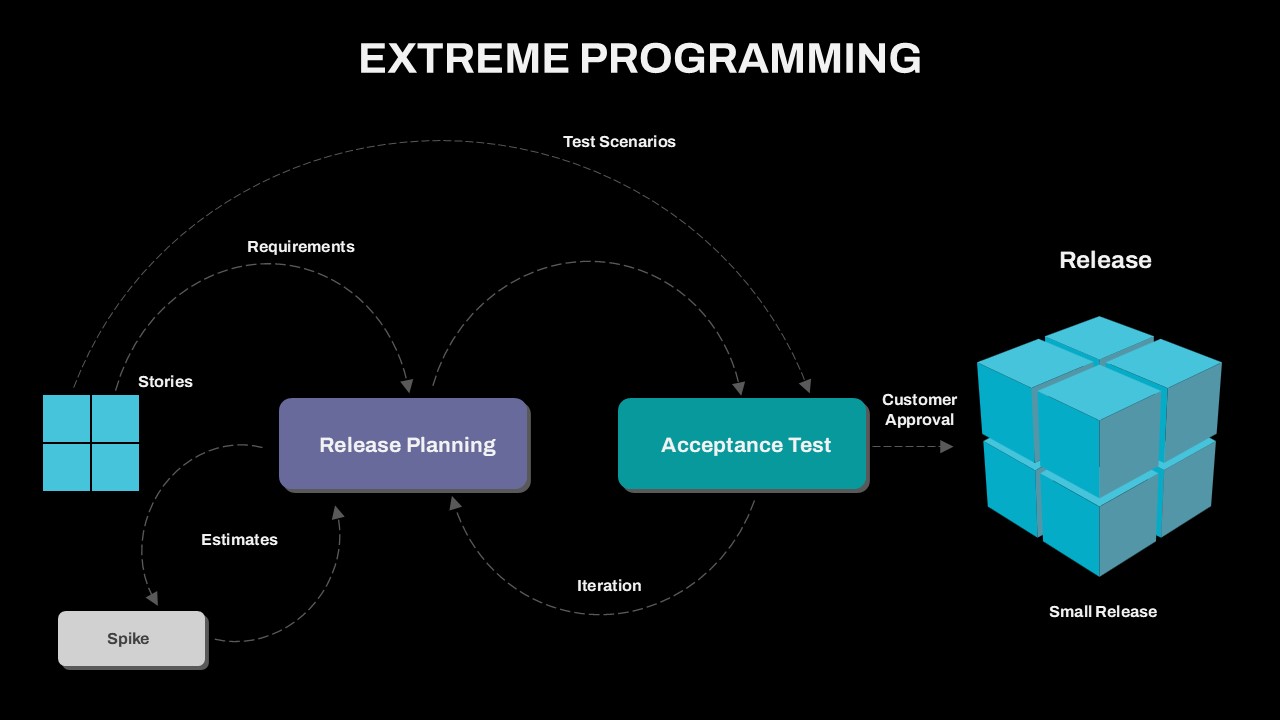
Agile engineering practices often create confusion when teams treat Extreme Programming (XP) as a simple set of ad-hoc tasks rather than a continuous, feedback-driven development loop. Built around a looped lifecycle diagram connected to an isometric modular release cube, this Extreme Programming process cycle template provides agile coaches, software architects, and engineering managers with a structured visual blueprint to communicate rapid iteration, testing cycles, and incremental software delivery.
The flow layout balances planning, exploratory research, and automated validation against tangible production releases. Scrum masters, development leads, and technical product managers can use this slide to align engineering squads, educate stakeholders on test-driven deployment, and present software development life cycle (SDLC) mechanics with clarity.
Where This Framework Adds Value
- Agile Coaching & Engineering Onboarding: Train development squads on the core feedback loops, user story estimation methods, and acceptance testing standards of XP.
- Sprint Release Planning Briefings: Clarify the relationship between user stories, exploratory spikes, and planned release schedules for product stakeholders.
- Quality Assurance & Testing Overviews: Demonstrate how automated test scenarios and direct customer approval gates protect software quality prior to production rollout.
- Software Architecture Reviews: Illustrate continuous delivery models where frequent, modular small releases reduce deployment risks and technical debt.
Core Strategic Focus Areas
The visual architecture maps the iterative mechanics of Extreme Programming from backlog definition to final deployment:
- User Story & Requirement Inputs: Incoming customer stories feed directly into requirements scoping and release planning milestones.
- Spike Research & Estimation Loop: Dedicated exploration pathways route uncertain estimates into technical spikes before returning grounded estimations to release planning.
- Iterative Acceptance Testing: Curved feedback arcs connect Release Planning directly with Acceptance Test execution, driving continuous iteration cycles.
- Incremental Modular Release: Verified builds pass through customer approval checkpoints into a modular cube structure representing manageable, continuous small releases.
Layout Highlights
- Clean header section anchors the presentation with bold typography under the title “EXTREME PROGRAMMING”.
- Dual primary milestone containers in slate blue and teal highlight core operational anchors for Release Planning and Acceptance Test.
- Curved dashed line pathways clearly trace dependencies, feedback iterations, technical spike loops, and test scenarios.
- Isometric 3D block cluster on the right provides an eye-catching metaphor for modular, incremental code releases.
- Fully editable vector shapes and typography in Microsoft PowerPoint and Google Slides enable rapid adjustments to labels, color palettes, and workflow stages.
Check out more software development presentation slides.
Login to download this file

Item ID
SB05315


Related Templates

Computer Science Template for Technology, Programming & Cybersecurity Presentations
Information Technology
Performance Review Process Management Cycle template for PowerPoint & Google Slides
Employee Performance
Employee Life Cycle Activities Process Template for PowerPoint & Google Slides
Employee Performance

Creative Cycle Process Infographics Template for PowerPoint & Google Slides
Process
Modern Cycle Process Template for PowerPoint & Google Slides
Business Proposal
Communication Cycle Process Diagram template for PowerPoint & Google Slides
Business
Robotics Process Cycle Infographic Template for PowerPoint & Google Slides
Process
Business Process Analysis Cycle Diagram Template for PowerPoint & Google Slides
Business Strategy
Modern Cycle Process for PowerPoint & Google Slides
Infographics
Cycle Process PowerPoint Template
Process
4 Stage Cycle Process PowerPoint Template
Process
Four-Stage Process Cycle PowerPoint Template
Process
4 Step Cycle Process Diagram
Process
Four-Point Arrow Cycle Diagram Template for PowerPoint & Google Slides
Arrow
Continuous Improvement Cycle Diagram Template for PowerPoint & Google Slides
Process
Release Management Cycle Circular Diagram Template for PowerPoint & Google Slides
Software Development
Working Capital Cycle Diagram Template for PowerPoint & Google Slides
Circular
Gartner Hype Cycle Adoption Curve Diagram Template for PowerPoint & Google Slides
Infographics
ML Development Life Cycle Diagram Template for PowerPoint & Google Slides
Machine Learning
Cashflow Management Template for PowerPoint
Finance