














Vrooms Expectancy Theory Template
Vroom’s Expectancy Theory Diagram for PowerPoint & Google Slides
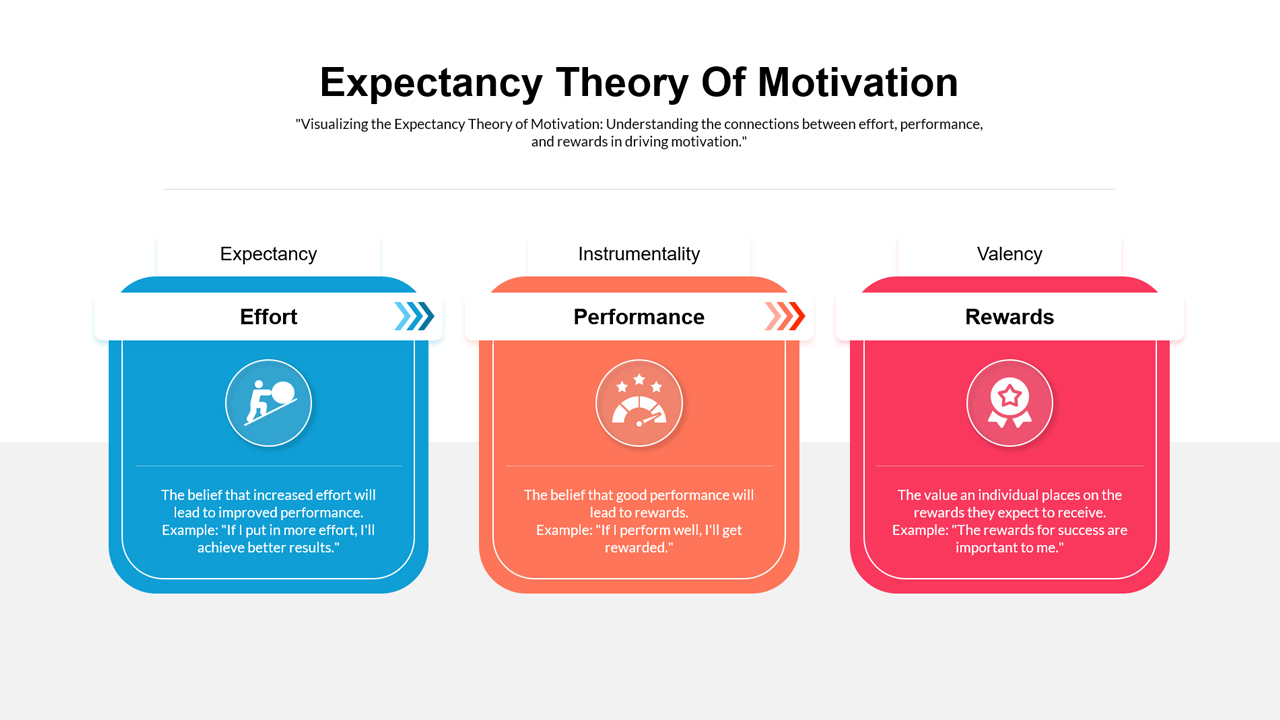
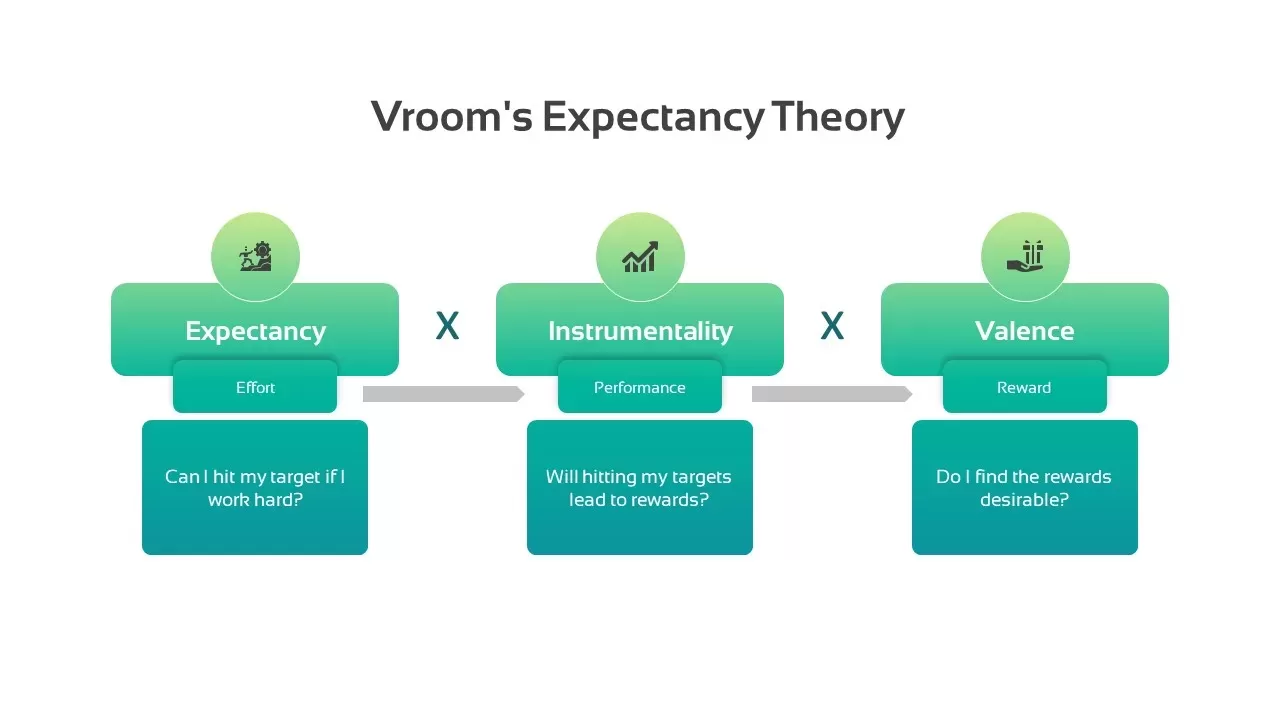
Vroom’s expectancy theory states that people’s motivation depends on three core elements: expectancy, instrumentality, and valence. Victor Vroom correlates these crucial factors directly with workplace motivation and organizational performance management. If an employee can make active choices in their work environment, obviously, they will choose the path and element that motivates them most. That means employees rationally consider the relative attractiveness of all possible incentives, rewards, and outcomes of a specific action.
Besides, individuals or employees also consider how much performance and effort must be put in for that desirable outcome. In a nutshell, the motivation behind behavioral selection is determined entirely by the desirability of the outcome. So, when you put in an effort, it will be based explicitly on the expected results. Unless the expected result is in line with an employee’s actions and personal goals, they won’t be ready to put effort into that matter. This makes our expectancy theory PowerPoint template an invaluable asset for showcasing these psychological behavioral shifts in business.
Three Elements of Vroom’s Expectancy Theory Diagram
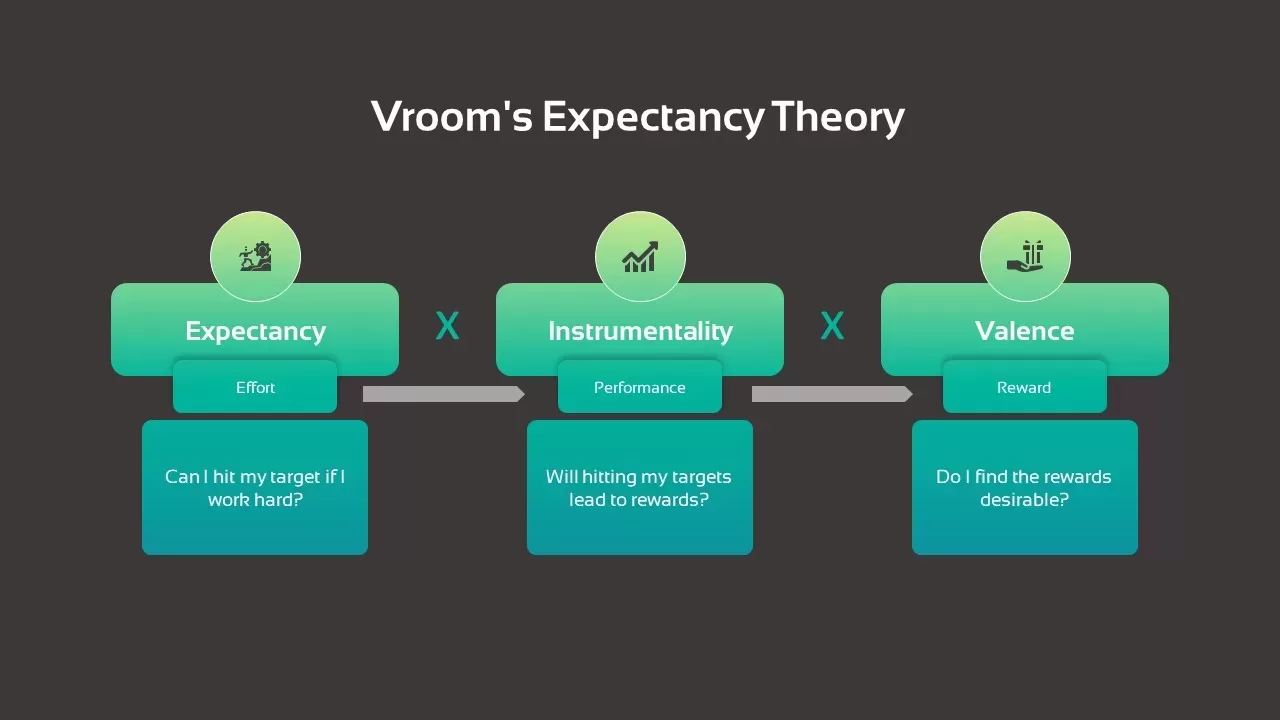
- Expectancy: This is the expected outcome that employees look to get from their direct efforts, which is heavily related to achieving a good performance review. It is also deeply connected with the perceived level of difficulty and what the individual experiences on the job. Organizations looking to maximize output should focus on which environmental factors can motivate the employee to get his best possible performance. Therefore, the expectancy theory model states there is a direct correlation between performance and sources of motivation, claiming that more effort leads to better performance.
- Instrumentality: Instrumentality means employees are likely to receive a designated reward if the baseline performance expectation is met. Organizations can easily boost workplace motivation by making clear promises of extra rewards, such as job promotions, corporate recognition, or financial bonuses.
- Valence: Individuals value corporate rewards based on their unique personal goals, individual needs, and internal sources of motivation. Because of this, the value of rewards is differently perceived by various individuals. For example, some team members prioritize money and financial compensation, while others simply want workplace recognition. So, it is incredibly important for leadership to find out true employee values to properly frame a sustainable source of motivation.
Our Vroom’s expectancy diagram template for a PowerPoint presentation is notably an essential management theory PPT based on psychological attributions. The template features a clean, professional horizontal design layout that shows all the key elements in a clear, scannable view.
Download Vroom’s expectancy theory template for an education PowerPoint presentation or corporate HR meeting today. Don’t forget to also check out our wide collection of other motivation theory PowerPoint templates and Google Slides themes to create a serious discussion during your next business review meeting.
Login to download this file

Item ID
SB02969


Related Templates

Expectancy Theory Of Motivation Template
Process
Theory X & Theory Y Template for PowerPoint
Comparison
McGregor’s Theory X and Theory Y Template
Business Strategy
McGregor’s Theory X And Theory Y Slide
Comparison

Theory Of Change Template PPT Slide
Process
Incentive Theory of Motivation Diagram Template for PowerPoint & Google Slides
Employee Performance
Herzberg’s Two Factor Theory Template
Comparison
Bandura’s Self-Efficacy Theory Template for PowerPoint & Google Slides
Process
Pickle Jar Theory PowerPoint Template
Business Strategy
Newton’s Apple Theory PowerPoint Template
Graphics
Inner Work Life Theory PowerPoint Template
Employee Performance
Social Learning Theory PowerPoint Template and Google Slides
Circular
Empirical Process Control PowerPoint Template
Circular
Complexity Leadership Theory Overview Template for PowerPoint & Google Slides
Leadership
Ethical Leadership Theory Framework Template
Leadership
Gardner’s Multiple Intelligences Theory PowerPoint Template
Leadership
Queuing Theory System Flow Diagram Template
Process
Maslow’s Hierarchy of Needs Theory of Motivat
Pyramid
Competency Theory Slide for PowerPoint & Google Slides
Employee Performance
Skinner’s Reinforcement Theory PPT & Google Slides
Comparison