
Pitch Decks – The Complete Guide [Real Insights from REAL CEOs]
 |
May 13th, 2026
|
May 13th, 2026



You’ve got a business idea you believe in. Maybe you’ve already built something. Now you need funding, a partner, or just someone in the right room to take you seriously. That’s where a pitch deck comes in.
But here’s the thing, most pitch decks don’t fail because the business is bad. They fail because the story isn’t clear, the slides are cluttered, or the founder walked in trying to close a deal instead of start a conversation. The difference between a deck that gets a follow up meeting and one that gets a polite “we’ll be in touch” is rarely about the idea itself.
This guide covers everything you need to know about pitch decks, what they are, what to include, how long they should be, and how to actually use one effectively.
👉🏽 We also spoke to founders, CEOs, and marketing leaders who have pitched in high stakes rooms and asked them what actually moves the needle. Their answers might surprise you.
What is a pitch deck?
A pitch deck is a short, visually-driven presentation (typically 10–20 slides) used by startups and businesses to communicate their idea, market opportunity, and funding needs to potential investors or partners.
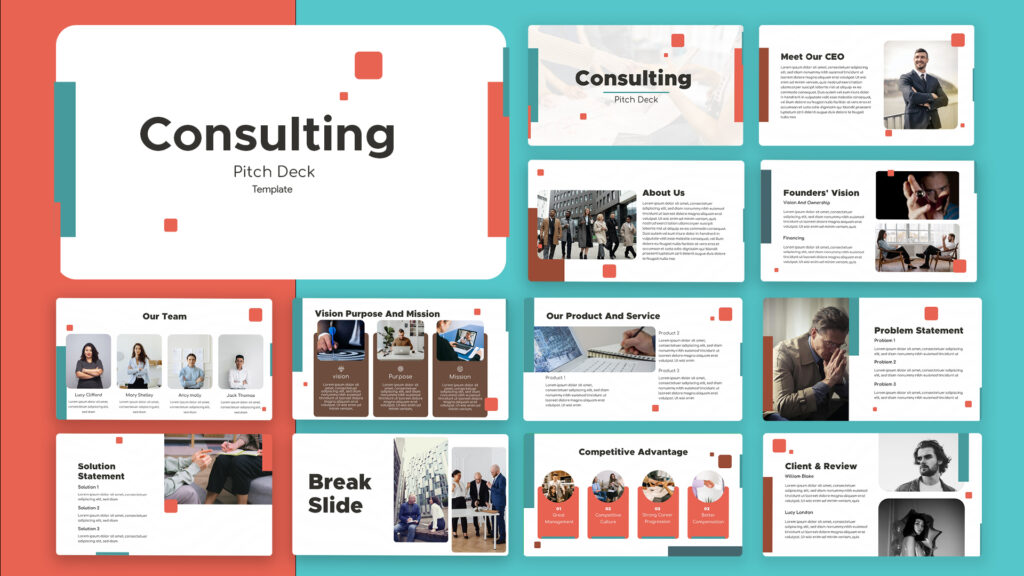
Think of it as a movie trailer for your business. Except you’re pitching that trailer to a producer to convince them to fund the full film.
The primary goal of a pitch deck is to spark interest and secure a subsequent meeting, rather than to get an immediate investment on the spot.
A good pitch deck covers the basics:
- The problem you’re solving
- Your solution
- The market size
- How you make money
- Traction and milestones (proof your idea works)
- Competitive analysis and differentiation
- Financial projections
- How much funding is required and how it will be used
- And why your team is the right one to pull it off.
Most investors want to see some traction, whether that’s early users, revenue, or partnerships, just something that shows the idea has legs.
There are a few different formats depending on what you need. A teaser deck is short, sometimes just a few slides, used mainly for cold outreach. A presentation deck is built around a live pitch, so it’s more visual with less text. And a standalone investor deck has enough detail that someone can read through it without you in the room and still get the full picture.
What is the purpose of a pitch deck?
The primary purpose of a pitch deck is to present your business idea in a way that’s compelling enough to get investors or clients interested in learning more.
❌ It’s Not About Closing a Deal on the Spot
This is something a lot of first time founders get wrong. The goal of a pitch deck isn’t to walk out of the room with a check. It’s to get a second meeting. Think of it as a tool designed to spark curiosity and open a conversation, not close one. If an investor finishes your deck and wants to know more, it has done its job.
What a Pitch Deck Actually Does
Beyond just asking for money, a well built pitch deck serves a few important purposes.
👉🏽 It shows investors that you’ve thought this through. The way you structure your narrative, handle your financials, and present your market understanding all signal whether you’re someone worth betting on. It’s as much a credibility check as it is a business overview.
👉🏽 It builds an emotional connection. Listing data points and projections alone won’t get anyone excited. The decks that land are the ones that make investors feel the problem, understand why it matters, and genuinely believe in the impact of the solution. That’s why storytelling frameworks work better than dry slide after slide of statistics.
👉🏽 It makes the financial case clearly. A good pitch deck communicates why your business needs to exist, how it plans to generate sustainable revenue, and exactly how the funding will be used to hit specific milestones. Investors aren’t just buying into an idea, they’re evaluating a return.
How to create a pitch deck?
To create a pitch deck, start with your story, then build your slides around it using a clear structure, clean design, and the right format for your audience.
Start With the Story, Not the Slides
Most people open PowerPoint and start typing. That’s usually where things go wrong. Before you touch any presentation software, figure out what story you’re telling. Investors don’t just respond to numbers, they respond to a logical progression that makes them feel like the opportunity is obvious.
Two frameworks that work well for this:
The POPP Framework structures your pitch around four questions:
- Why should I care? (Problem)
- Why should I join? (Opportunity)
- How will we win? (Plan)
- Why should I believe you? (Proof).
The Hero’s Journey frames your customer as the hero facing a serious problem, and your startup as the mentor handing them the tool to solve it. It’s a simple mental model but it keeps your pitch human and relatable.
Once you have the narrative locked in, the actual building part becomes much more straightforward. You know what story you’re telling, so every slide has a job. You’re not filling space, you’re making a case.
From there it’s mostly execution. Write your slides around the structure covered below, keep the design clean and consistent, and make sure each slide is carrying one clear idea. If you find yourself cramming two points onto a single slide, that’s usually a sign one of them needs its own slide or doesn’t belong in the deck at all.
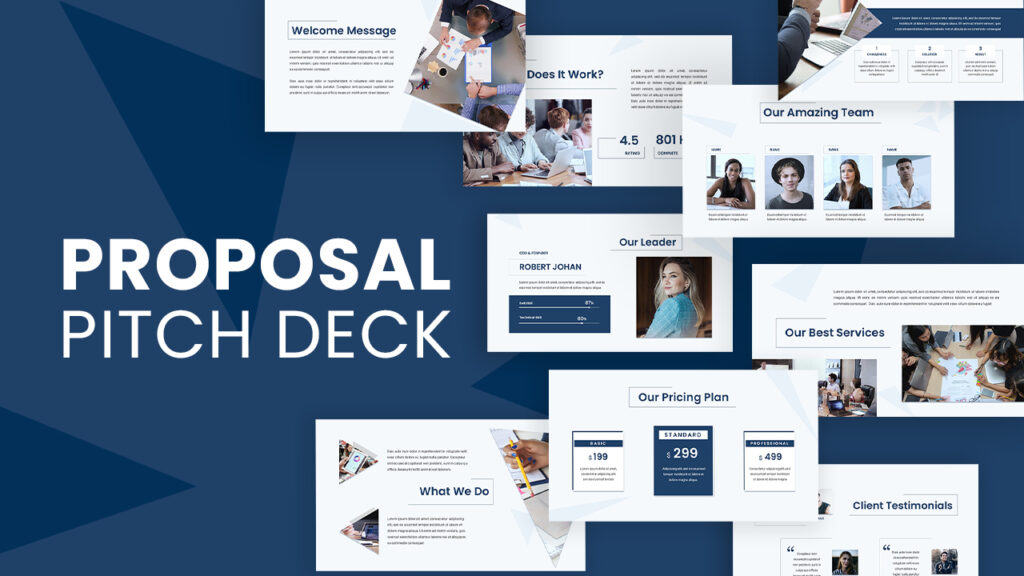
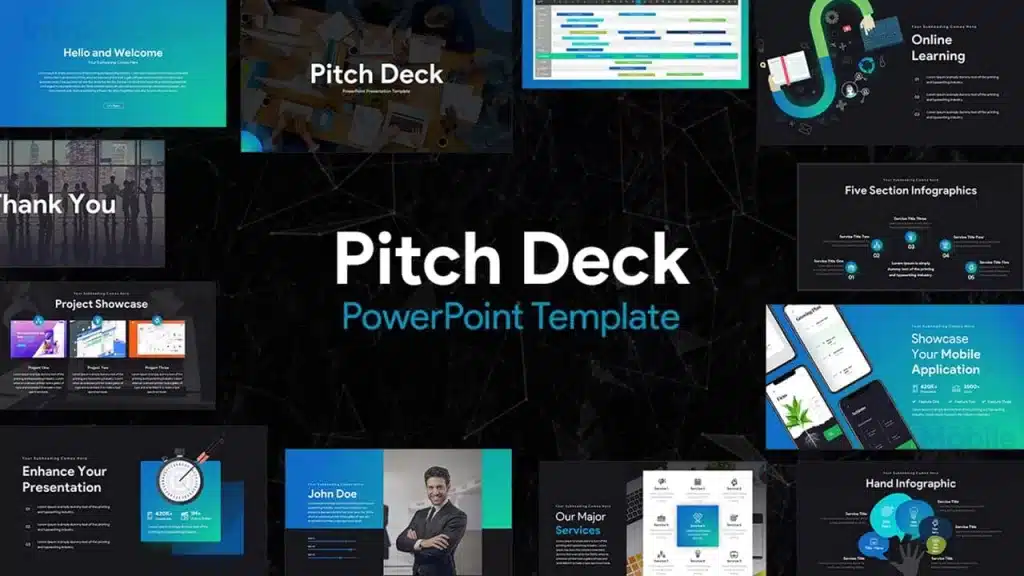
If you want to move faster, you don’t have to start from a blank canvas. SlideBazaar’s presentation templates are built for exactly this kind of work. Pick a layout that fits your pitch, drop your content in, and you’ve got a professional looking deck without spending hours on design. It’s a practical shortcut that lets you focus on the story rather than the formatting.
What should be included in a pitch deck?
Most successful pitch decks follow a 10 to 15 slide narrative arc that takes investors from the problem all the way through to the ask. Here’s what each section should cover:
Title and Company Purpose
Your opening slide should be clean and simple. Company name, logo, and one plain sentence explaining what your business does. No jargon, no fluff.
The Problem
This is where you set the stage. Define a specific, urgent pain point that your target audience is actually dealing with. The best problem slides make it feel like this issue is costing people real money, time, or sanity, and that it needs to be solved now, not eventually.
The Solution
Present your product or service as the direct answer to the problem you just laid out. Skip the long list of technical features and show it instead. A before and after comparison, a short demo, or a screenshot will always land better than a paragraph of descriptions.
Market Opportunity
Quantify the upside. Investors want to see your Total Addressable Market (TAM), Serviceable Available Market (SAM), and Serviceable Obtainable Market (SOM). Build this from the bottom up using real purchasing behavior, not broad population statistics that anyone could pull from a Google search.
- TAM (Total Addressable Market): The total global demand for your product or service. Essentially, the maximum revenue you could generate if you captured 100% of the market.
- SAM (Serviceable Addressable Market): The portion of the TAM that your business can realistically target based on your product, geography, and business model.
- SOM (Serviceable Obtainable Market): The slice of your SAM that you can actually capture in the near term, given your current resources, competition, and go to market strategy.
Product and Underlying Magic
Go a level deeper on how your product actually works. If you have proprietary technology, intellectual property, or something genuinely hard to replicate, this is where you highlight it. This is what investors refer to as your “underlying magic.”
Business Model
Explain clearly how you make money. Walk through your pricing strategy, whether that’s subscriptions, marketplace commissions, freemium tiers, or something else, and explain why that model makes sense for the market you’re in.
Go to Market Strategy
Lay out your execution plan for acquiring and keeping customers. Which channels are you using, what does your sales motion look like, and what are the specific tactics you’re relying on to grow. Investors want to see that you’ve thought beyond “we’ll post on social media.”
Competitive Landscape
Acknowledge your direct and indirect competitors honestly. Use a visual format like a 2×2 positioning matrix or a feature comparison table to show where you stand out. The goal is to demonstrate that you understand the space and have built something that occupies a position others can’t easily step into.
Traction and Milestones
Show proof that things are moving. Depending on your stage this could be pilot results, paid letters of intent, user growth numbers, or monthly recurring revenue. Concrete metrics only, no vanity numbers.
The Team
Explain why your specific team is the right one to execute this vision. Highlight domain expertise, relevant past wins, and how your skills complement each other. Investors bet on people as much as ideas, so this slide carries more weight than most founders realize.
Financial Projections
Present a realistic 3 to 5 year forecast covering your revenue streams, gross margins, operating expenses, and a clear path to profitability. Realistic is the key word here. Overly optimistic projections are easy to spot and immediately hurt your credibility.
The Ask and Use of Funds
State clearly how much you’re raising and exactly where that money is going. Break it down across categories like product development, marketing, and hiring, and tie each directly to the specific milestones that spending is meant to unlock. Vague answers here are a red flag.
Closing and Contact
End with a strong call to action and make it easy for investors to follow up. Clear contact details, a website, and a direct next step go a long way.
How long should a pitch deck be?
A standard pitch deck should be between 10 and 15 slides long, which gives you enough room to tell a compelling story without losing your audience’s attention.
Investors are busy. Research shows they spend an average of just 3 minutes and 44 seconds reviewing a pitch deck, so every slide needs to earn its place. If you’re presenting live, a good rule of thumb is Guy Kawasaki’s 10/20/30 rule: 10 slides, delivered in under 20 minutes, with fonts no smaller than 30 points.
That said, the right length depends on what you’re using the deck for.
A teaser deck is just 1 to 5 slides, built for cold outreach to quickly get someone’s attention and land a first meeting.
An investor deck runs 10 to 20 slides and contains enough detail that someone can read through it on their own without you in the room.
An extended deck can go up to 25 slides, but this is typically only used during deeper due diligence when investors are already serious and want the full picture.
When in doubt, keep it shorter. A tighter deck that covers only what matters will always outperform a longer one that buries the important stuff.
How to do a competitor analysis pitch deck?
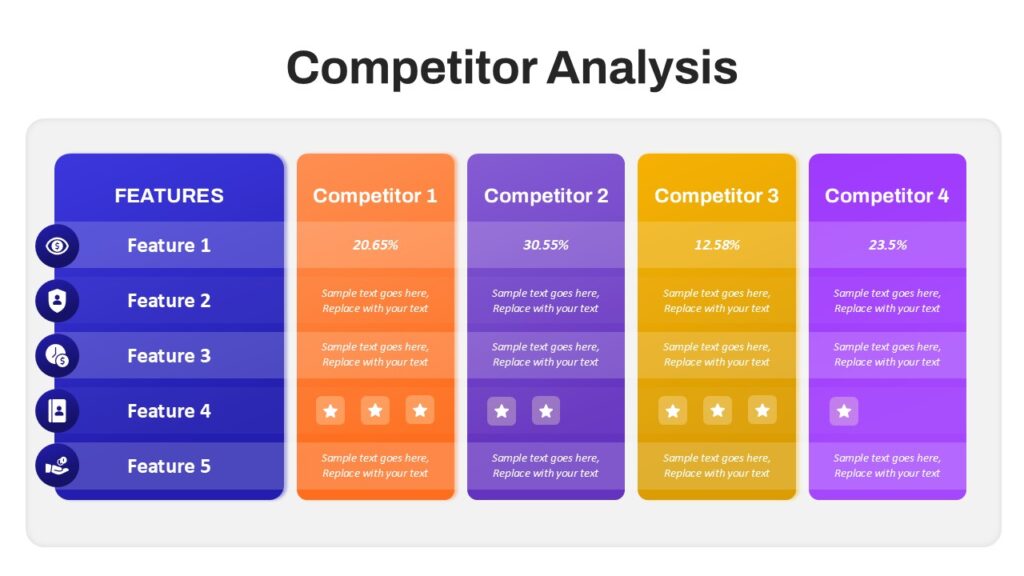
A competitor analysis slide in a pitch deck compares your business against the key players in your space to show investors, at a glance, why your startup stands out.
Never Say You Have No Competition
This is the most common mistake founders make on this slide. Claiming you have no competitors is a red flag for investors. It either means you haven’t done your research, or there isn’t enough market demand to have attracted any players yet. Neither is a good look. You need to acknowledge both your direct competitors and your indirect ones.
Use a Visual Format, Not a Wall of Text
Nobody wants to read a dense paragraph comparing five different companies. Pick a visual framework and map out 3 to 5 direct competitors using one of these formats:
A 2×2 Positioning Matrix: You plot competitors along two axes, something like Price vs Quality, and position your company in the winning quadrant. It’s simple, easy to read, and makes your advantage obvious in seconds.
A Feature Comparison Table: A straightforward chart listing features, pricing, or target markets across competitors. The goal is to show clearly where competitors fall short and where you come out on top.
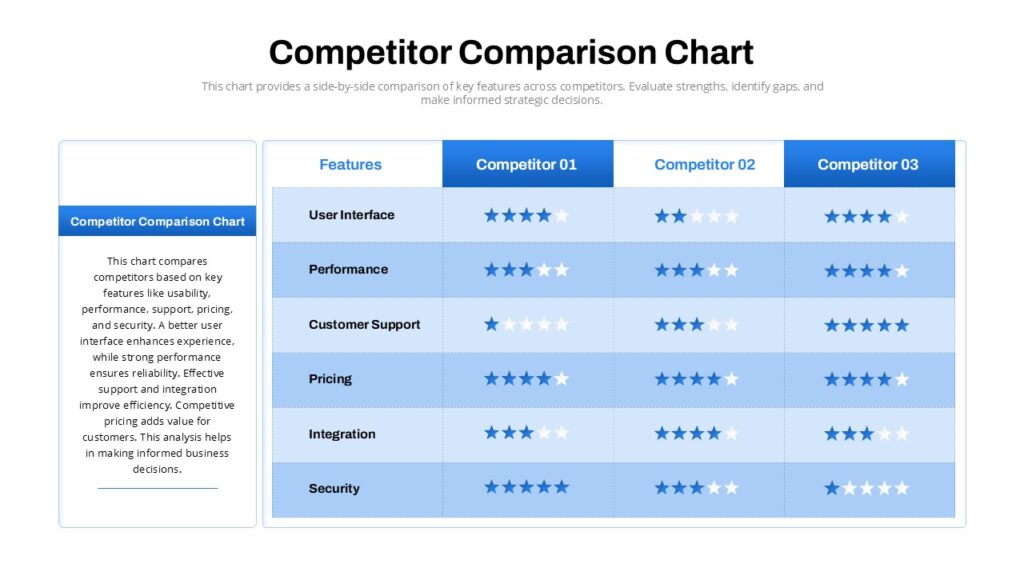
Competitor Groupings: If the market is too crowded to list individual companies, group them into categories instead. Dropbox did this well. They pointed out the universal flaws in each category of existing solutions before revealing why their approach was fundamentally different.
Be Honest About What Competitors Do Well
Don’t position yourself as the best at everything. Investors will see right through it and it makes your whole slide less credible. Acknowledge where your competitors are strong, then reframe it in a way that still highlights your positioning. Uber’s early pitch deck is a good example of this done right. They didn’t pretend taxis didn’t exist or weren’t deeply embedded in daily life. They acknowledged it, and then made the case that taxis were slow and unreliable, which made Uber’s value proposition feel inevitable rather than aspirational.
Show That Your Advantage is Hard to Copy
A strong competitive edge isn’t just a feature, it’s a moat. Investors want to see that what makes you different is structural and difficult to replicate over time. Some examples of what that looks like:
Financial and economic advantages like lower customer acquisition costs, higher gross margins, or better capital efficiency compared to competitors.
Product and operational moats like proprietary technology, exclusive integrations, high customer switching costs, or network effects that get stronger as you grow.
The point of this slide isn’t to tear down your competition. It’s to show investors that you understand the landscape clearly and that you’ve built something that occupies a position nobody else can easily step into.
What Experts Say About Delivering a Pitch Deck
Building a great pitch deck is one thing. Knowing how to use it is another. We reached out to founders, CEOs, and marketing leaders who have been in high stakes rooms and asked them what actually moves the needle. Here’s what they had to say.
👉🏽 One of the more counterintuitive lessons comes from Peter Moon, CEO at Herba Health Inc.:
“The secret behind an impactful pitch is knowing what NOT to say, not the amount of information included. Any investor wants to be sure there is at least one thing that proves your idea worth his money, but adding all sorts of additional numbers makes that point weaker. From my experience, a slide presentation that attempts to answer everything before the audience asks the questions shows insecurity. Let your presentation raise interest in your product and attract attention, then take advantage of the Q&A to impress with your expertise.”
That last point is worth sitting with. A lot of founders treat the pitch as the finish line when it’s really just the opening of a conversation.
👉🏽 Aaron Whittaker, VP of Demand Generation and Marketing at Thrive Internet Marketing Agency, learned this the hard way after a boardroom pitch that felt like a success but quietly fell apart afterward:
“What became clear later was that the client team had walked away with different expectations tied to their roles. Marketing was thinking about increasing traffic volume, sales expected more qualified meetings on the calendar and operations was already questioning whether their team could handle the potential increase in lead flow. Everyone agreed the strategy made sense in isolation but there was no shared understanding of the specific outcome they were committing to.”
That experience reshaped how he structures every pitch since. His fix was simple but disciplined: build the entire presentation around one clearly defined outcome tied to revenue or pipeline, and never let the room leave without a concrete next step. In one pitch that followed this approach, he closed a $92,000 deal within two weeks.
“What I’ve learned from leading and training these teams is that effective presentations are not about covering more ground or adding more detail but about creating alignment around a single outcome so the decision becomes clear and easier to move forward.”
👉🏽 Leah Miller, Marketing Strategist at Versys Media, shared a moment that stuck with her from a pitch she supported:
“One moment that genuinely caught me off guard was when an investor paused halfway through a pitch and said, ‘We were ready to say no based on your deck alone, but the way you framed the problem just changed the conversation.’ It was a stark reminder that structure and narrative often matter more than beautifully designed slides.”
Her approach is to build the narrative around tension rather than features, design for the decision you want the room to make, and treat the first and last 60 seconds like ad creative. On rehearsal, she takes a different approach than most:
“Rather than endless solo run-throughs, we simulate hostile or skeptical questions. In a recent SaaS pitch, we sat the founder down with our performance strategist and asked only questions about risk, assumptions, and timelines. We then rewrote 4 slides to pre-empt those objections visually and verbally. That session changed the founder’s delivery from defensive to confident, which investors picked up on immediately.”
👉🏽 Thomas Oldham, Founder of WebMotion Media, puts it bluntly when it comes to what actually closes deals:
“Closing deals hinges on two things. First, I tailor every slide to the client’s specific pain points. Second, I quantify the ROI upfront. In my experience, deals with a direct ROI projection close at double the rate of vague pitches.”
He also shared a moment from a live pitch where the audience was visibly checked out. Rather than pushing through the deck, he stopped completely and walked the room through a single metric. That one data point pulled everyone back in.
👉🏽 Kirill Meshyk, Head of AI Data Collection at Unidata, makes a point that most founders don’t want to hear:
“A presentation is not about your slide deck; it’s all about you as a presenter, while your slides exist merely to complement what you know.”
In one pitch to a potential strategic partner, he cut his deck from 22 slides down to 9. Bullet points were replaced with numbers, and every slide that explained what the company does was removed entirely. Only the results slides stayed.
“Potential does not sell in paragraphs; only results can fit on half a page.”
The pitch closed in a single meeting.
👉🏽 Vitaly Yago, CEO of PhotoGov, describes the pitch not as a demonstration but as a tool for managing attention. His team restructured their investor pitches around three questions: what does it provide, why now, and what risks have we already mitigated. When they removed 70% of their technical detail and replaced it with a single concrete case study, the reaction in the room shifted completely.
“The conversation went from ‘interesting’ to ‘let’s discuss the terms.'”
His framework for training presenters is straightforward: one slide, one solution. Lead with the conclusion, not the rationale. And if a question comes up during the pitch, treat it as a sign that a risk wasn’t addressed on the slide.
👉🏽 Pavankumar Kamat, Co-Founder and CEO at Panto AI, approaches pitch preparation as a repeatable system rather than a one-off effort. One of the frameworks he uses is what he calls Triple-A:
“Audience, Ask, Answer. Tailor the evidence to the audience’s incentives, state the ask explicitly, and pre-answer their top three objections.”
He also advocates for leading with the biggest perceived risk and answering it head on with data or a concrete contingency. His reasoning: investors and boards are ultimately voting on risk reduction, not on how polished the storytelling is.
👉🏽 Finally, Mark Voronov, Co-Founder and CEO of Uproas, cuts to the heart of what separates a forgettable pitch from one that lands:
“A great presentation is not about how impressive your slides are; it is about how confidently you can defend every claim you make if someone smart tries to shoot holes in it.”
His view is that the best pitches aren’t built on slides at all. They’re built on preparation for the worst objections. The deck is just the surface. What’s underneath it, your ability to read the room, handle pushback, and stay present when things go off script, is what actually closes the deal.
Conclusion
A pitch deck is not a magic document. It won’t close a deal on its own, and a beautifully designed one won’t save a story that isn’t clear. What it will do, when built well, is open doors that would otherwise stay shut.
The fundamentals are straightforward enough: know your story before you touch a slide, keep it focused, show proof, and make it easy for the person on the other side to say “tell me more.” Everything else, the frameworks, the formats, the design principles, is just in service of that one goal.
If there’s one thing the experts in this guide consistently came back to, it’s preparation. Not preparation for the pitch itself, but preparation for what comes after it. The questions, the pushback, the moments when the room stops following the script. That’s where deals actually get made.
Build the deck. Know it cold. Then be ready to put it down and have the real conversation.
Related Articles
-
 July 26th, 2024
How to Activate or Re-enable a Disabled PowerPoint Add-in
Blog Post -
 January 29th, 2021
Performance management – Objectives & Approaches
Blog Post -
 March 11th, 2025
SlideBazaar AI Web App – Beta version is live!
Blog Post